
Artificial intelligence
When does a business need an AI bot, and when does it need automation?
A practical framework for choosing an AI bot, rule-based automation or a hybrid: examples, risks, human oversight and a measurable pilot.
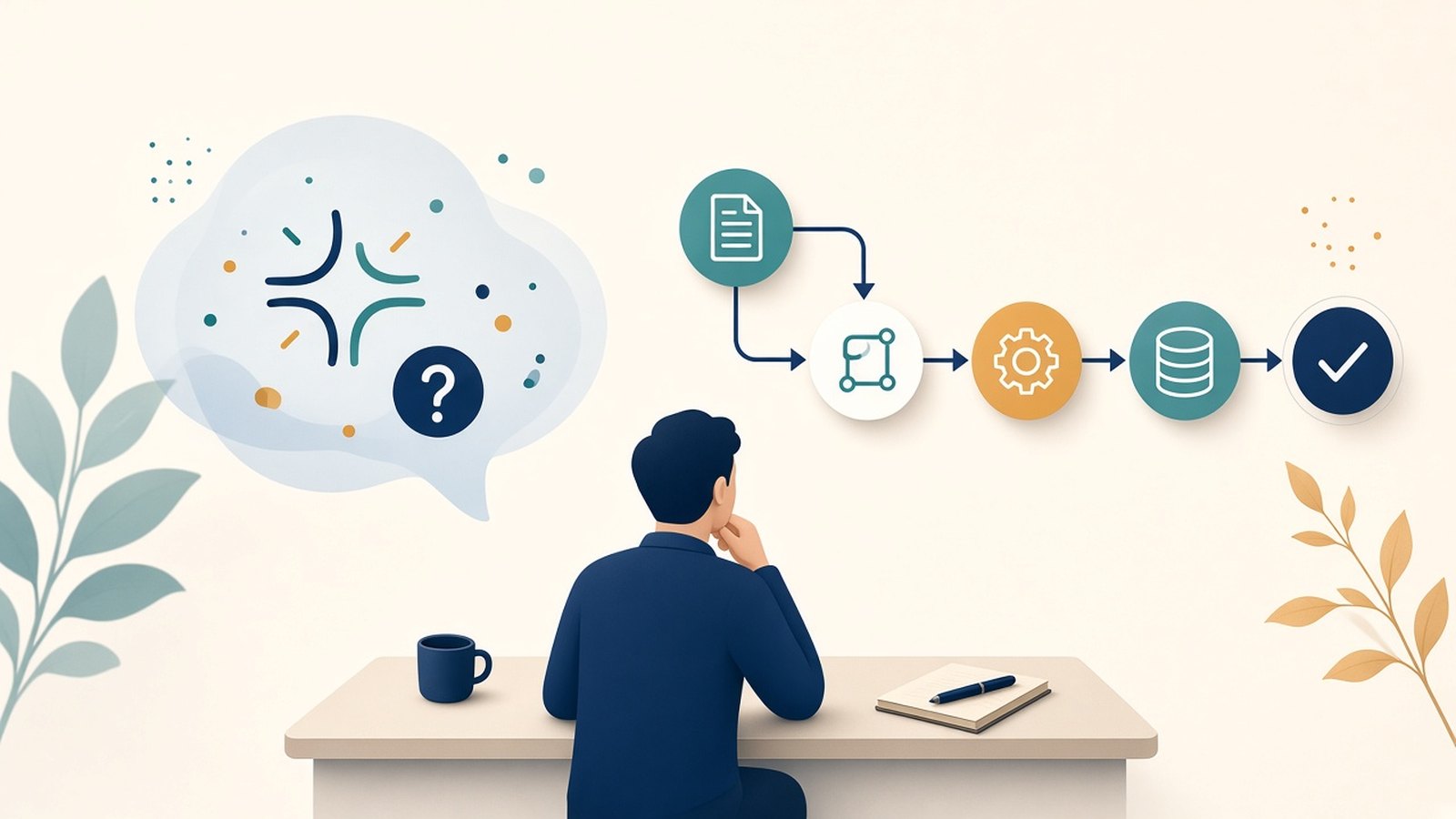
A business needs an AI bot when its main challenge is understanding varied questions and helping people find information. Automation is a better fit when a task follows clear rules: an event triggers a check and a specific action. Sometimes the sensible answer combines both, but a conversational interface does not, by itself, make a process reliable.
For a small or medium-sized business, the useful question is not “Which tool is newest?” but “Where exactly do we lose time, and what happens if something goes wrong?” The following framework supports an initial decision without assuming a large budget, an in-house AI team or automatic business growth.
Start with the work, not the technology
Choose one recurring task and describe its starting point, inputs, expected outcome and responsible employee. “Handling enquiries” is too broad. “Moving form submissions into the CRM and creating a task for a salesperson” is concrete enough to assess a solution.
Follow several real cases, including awkward ones: incomplete information, duplicate enquiries and an unavailable external system. If staff cannot explain the next step in those situations, clarify the process first. Neither a bot nor an integration can decide the right business policy on its own.
When an AI bot can help
A bot can be useful when people ask similar questions in many different ways. It may help them navigate instructions, summarise approved information or prepare a response for review. Our existing introduction to AI bots (in Bulgarian) covers the basics.
A limited knowledge base with current documents and a named owner is a sensible starting point. The bot should be able to say that information is insufficient and hand the case to a person. Confident wording is not evidence of accuracy, and having a document does not guarantee correct interpretation.
Hypothetical example: an office equipment supplier receives questions about compatibility and maintenance. A bot points to approved instructions and asks for the product model. It does not promise a discount, availability or a warranty decision without a verified source and permission to do so.
When automation is the better choice
Clear rules often require no language model. A form can validate required fields, check for duplicates, record an enquiry in the CRM and create a task. This is rule-based automation, without the need for open-ended conversation.
Predictable steps do not eliminate risk. Access controls, execution tracking and protection against repeated actions are still necessary. If a connection drops after a task has been created, a retry should not create another copy.
Hypothetical example: after a confirmed payment, a system prepares service access and a notification. Payment is checked against a reliable record, not a statement in a chat. If records disagree, the process stops and alerts an employee rather than guessing what happened.
A short table for an initial decision
| Situation | Sensible starting approach | Essential check |
|---|---|---|
| Varied questions about approved documents | A narrowly scoped AI bot | Sources and human handover |
| Identical steps after a form or event | Rule-based automation | Validation, duplicates and failures |
| Free text followed by a clear action | A hybrid solution | Confirmation before execution |
| Unclear rules or contradictory data | Clarify the process first | An owner and a current source |
When a combination makes sense
Conversation and execution are separate layers. A bot can identify an intention and propose a structured request. A separate process then checks fields, permissions and allowed actions. For an order change, for example, the customer confirms the specific details before the system proceeds.
Do not give the model blanket permission to do anything in the CRM or shop. Limit tools to specific functions and keep important decisions subject to approval. A predefined workflow can contain an AI step, but that does not make the whole process deterministic: assess possible model errors too.
This article is about selecting a first business process, not ranking architectures. For the more technical distinction, see AI agents and AI workflows (in Bulgarian). The principle is to add complexity only when a simpler approach cannot meet the need.
Data, privacy and human oversight
Before a pilot, establish which data leaves your systems, which provider processes it, how long it is retained and who can access it. Do not send an entire customer archive when one limited record is sufficient. Start with fictional or appropriately anonymised examples, not sensitive correspondence.
When personal data is involved, assess the applicable lawful basis, transparency, contractual arrangements and necessary safeguards. Data minimisation and storage limitation are GDPR principles. This practical checklist does not replace a legal assessment, particularly for sensitive data or decisions with significant consequences.
Also define when a person takes over: conflicting sources, a complaint, a refund request or an unclear enquiry. Enforce permissions outside the model. Text supplied by a customer or document must not, on its own, expand access or override process rules.
A pilot with a clear success criterion
Limit the first test to one channel, one task type and a specific group of users. Record the current process: handling time, errors and corrections. Then compare similar cases, including time spent on human review, maintenance and fixing problems.
For a bot, check answers against their sources and test appropriate handover to staff. For automation, check completed steps, duplicates and recovery after interruptions. Try missing fields, invalid values and an unavailable integration. One successful demonstration conversation is not enough for a launch.
A checklist before deciding
- Can we describe the task and its outcome in one sentence?
- Do we need an open-ended conversation, or would a structured form be enough?
- Who keeps the rules and sources current?
- Which actions need confirmation, and who provides it?
- How do we stop the process and resume manual work if something fails?
- How do we measure quality and total cost rather than speed alone?
If these answers are missing, the next step is a process map, not another tool purchase. If they are clear, start with the smallest solution you can verify and maintain. If relevant, explore Hostado’s business process automation and systems integration service (Bulgarian page) and describe your specific steps, systems and constraints. That provides a basis for a realistic discussion without promising an outcome in advance.
Sources
- Anthropic: Building effective agents - simplicity, predefined workflows and oversight.
- Regulation (EU) 2016/679 - Articles 5, 6, 25 and 32 on principles, lawfulness and data protection.